Check out the November Edition of the Ice Times Newsletter.
Included this month:
- AFHL Rivalry Week
- October’s Stars of the Month
- Player Pledge Contest Winners
AND MORE!






Ice Times Newsletter
 Check out the November Edition of the Ice Times Newsletter.
News
Every year, as the holiday season arrives, the hockey community across Alberta steps up in remarkable ways. Rinks fill with more than just practices and games they overflow with generosity, teamwork, and a shared commitment to giving back. It’s a time when teams look beyond the scoreboard and focus on making a meaningful impact in their communities.
Last season, 49 teams participated in Hockey Gives Back, each contributing their own unique story of kindness. From community food drives, warm winter clothing collections, and from volunteering in seniors’ homes to supporting local charities, these teams demonstrated what makes hockey in Alberta so special: the culture, the connection, and the willingness to help others.
This year, Hockey Alberta is excited to continue highlighting the incredible initiatives happening in rinks and communities across the province. And while we were inspired by the 49 submissions we received last year, we know there are even more stories waiting to be told. Stories driven by players, coaches, managers, families, and entire communities rallying behind meaningful causes.
Here are examples:
This initiative not only strengthens the communities we live in, but it also strengthens the teams themselves. When players step off the ice to work together on a cause, they build something far bigger than hockey skills. They develop empathy. They learn leadership. They see the impact a team can have when everyone contributes. These moments become defining memories for young athletes, shaping how they see the world, and how they choose to make it better.
As we head into the 2025 holiday season, we want to feature even more stories. Whether your team has already planned a community initiative or is just getting started, we invite you to share your story with us. Tell us what inspired your team. Tell us who you’re supporting and why. Tell us what it meant to your players, your parents, and your community.

Membership Monday
The excitement surrounding First Shift continues to grow, with 31 programs being hosted across the province this season. From Grande Prairie to Canmore and in communities like Edmonton, Cochrane, Calgary, Tsuut’ina Nation, Chestermere, Lethbridge, Brooks, Ardrossan, Lamont, Red Deer, and Fort McMurray associations are preparing to welcome children who may be stepping into the world of hockey for the very first time.
The NHL/NHLPA First Shift Program is built on a simple but powerful goal: remove barriers and create a memorable, positive first experience for new-to-hockey families. Designed for kids who have never played before, it provides both the equipment and the confidence needed to enjoy the game at its best. As Vansickle explains, “It’s an excellent opportunity to get more kids interested in the game of hockey. It’s an affordable option for families who may have children not yet playing”.
At the heart of First Shift is the Welcome Event, a day crafted to replace any uncertainty with excitement. Vansickle walks us through what families can expect when they arrive for the first time.
“The day begins with our own LMHA volunteers, where we meet the Bauer reps early in the afternoon to get things set up and organized for the soon to becoming players that arrive. They show up and collect their gear; they go station to station and Bauer reps are present to fit to make sure they get the proper size equipment. By the end of the cycle, they walk out with the full bag of hockey equipment and great big smile on their faces. They’re ready to start their hockey journey”.
The Welcome Event is followed by six on-ice sessions over the next eight weeks, each designed to build confidence and help children fall in love with the game at their own pace.
For anyone considering the program but unsure whether hockey is the right fit, Vansickle has a clear message:
“If you have a child who’s on the fence about hockey, the Bauer First Shift Program is absolutely phenomenal. I encourage any association to jump on board and have your own First Shift program.”
Registration remains open for several First Shift programs beginning in January 2026. Welcome Event dates are posted, and families can expect their six ice sessions to run within the eight weeks that follow.
For families looking for an easy, welcoming, and memorable introduction to hockey, First Shift just might be the perfect first step.
News

Membership Monday
The Northwest Warriors are proving that hockey is more than just a sport, it’s a vehicle for building stronger, more connected communities. As one of Calgary’s most community driven associations, the Warriors have embraced growth, change, and the evolving community of hockey, all while staying true to their grassroots values.
Matt Hunter, Manager of Hockey Operations, says the Warriors’ deep roots within their local neighborhoods make them unique.
“Our association is unique due to its deep ties to our communities. The warriors have changed with the hockey landscape in Calgary, but truly still have a closer relationship with the initial crow child in Westwood communities that host our arenas. As we grow, the goal is to continue building on these programs that really use hockey as a vehicle for community development. Understanding that we have a responsibility to those under our care to provide a safe environment, and that kids can really flourish if they feel comfortable and valued”.
Their commitment to inclusivity and community connection can be seen in every aspect of the organization’s work. From youth development to volunteer engagement and their growing Diversity, Equity, and Inclusion (DEI) Committee.
Through the DEI Committee, the Warriors have launched several initiatives that are shaping a more inclusive and welcoming hockey culture. Their Girls Hockey Day continues to expand each year, supported by a passionate team of volunteers. They’ve also introduced a female coaching program, which has seen remarkable success, with nearly every team now having a female coach, and this season marking the association’s first-ever female head coach for a senior Timbits team.
“We do have a few different programs and initiatives that we are trying to grow because as an association the Northwest Warriors are growing and the goal is to continue growing,” said Beth McIvor, NWW DEI Committee Representative.
The Warriors’ DEI Committee has worked closely with local post-secondary institutions such as Mount Royal University and the University of Calgary, as well as with Hockey Alberta, to align initiatives and messaging across the hockey community. This collaboration has led to the successful integration of the Hockey Alberta Player Pledge, which the Warriors have adopted at every level from players and coaches to parents and volunteers.
“We have not just coaches and players taking the pledges here,” McIvor added. “We’ve invited the parents to join. We’re trying to bring a much more holistic approach to it, to ensure that everybody’s on the same page, everybody’s involved, and working towards the same goal, which is, again, just having a safe, inclusive space for kids to grow in sport.”
“As President of the Northwest Warriors, I proudly support the Hockey Alberta Player Pledge. Our organization believes that hockey is truly a sport for everyone. Diversity, equity, and inclusion strengthen not only our teams but our entire community. By embracing the Player Pledge, we are committed to fostering a culture of respect, fair play, and belonging both on and off the ice. Together we are building a hockey community for everyone,” said Sean David, President of the NWW.
For many families, this sense of belonging and purpose is what makes the Warriors special.
Beth, a parent and DEI committee member, shared her perspective: “I think as a parent and a leader in the community, the Northwest Warriors are very inviting and as Hockey Alberta has been of parents such as myself, who are just looking to volunteer and move the needle. There’s such bigger systemic and economical issues that play into kids in sport and kids in hockey, and sometimes it really feels like an uphill battle, it feels like you’re hardly moving the needle, but I think the challenge and the exciting part of it is to not get disheartened and just to keep going because every little bit of change helps and matters.”
Her message to other parents is clear, get involved. “Even if you think as a parent, there’s nothing I can do, I shouldn’t volunteer. Do it anyway. Volunteer. Northwest Warriors are always looking for new members to join the DEI Committee, and there’s tons of opportunities to get involved, especially if you’re an expert or a professional or a leader in the field. We welcome you.”
For the Northwest Warriors, hockey will always be about more than wins and losses. It’s about community, connection, and creating a space where everyone feels like they belong. Through continued collaboration and commitment to inclusion, the Warriors are setting a standard for what it means to truly live out the spirit of “It Starts With Us.”
Home Ice Feature
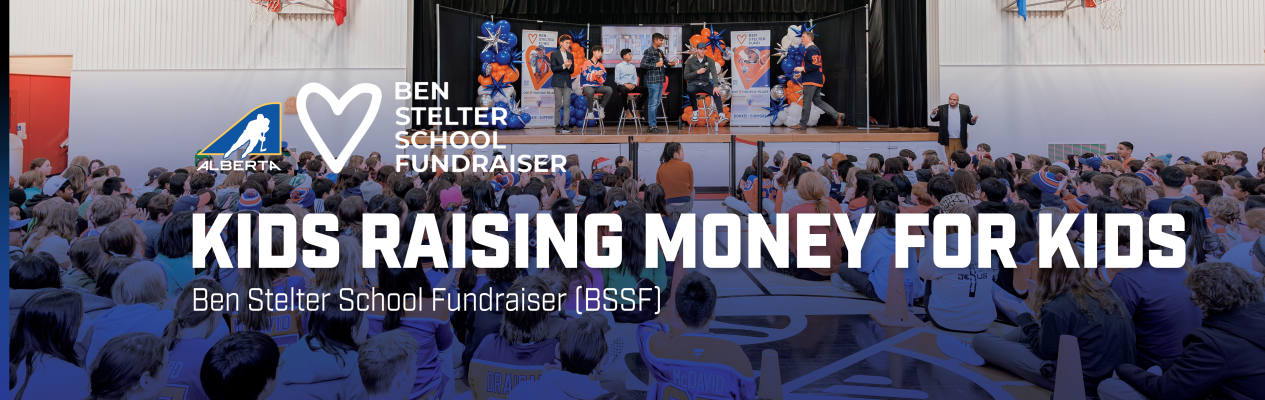
What began as one student’s idea to honour a young Edmonton hero has grown into uniting schools, inspiring compassion, and driving change for kids across Canada.
The Ben Stelter School Fundraiser (BSSF) was created in February 2023 to celebrate the legacy of Ben Stelter, the six-year-old Edmonton Oilers superfan whose courage and joyful spirit touched hearts nationwide. Ben’s battle with glioblastoma, a rare and aggressive brain cancer, moved the entire hockey community. After his passing, students wanted to keep his impact alive, not just in memory, but through meaningful action.
That inspiration sparked an idea from Aariz Mawji, now the director of the BSSF. He launched the first fundraiser at his school, where students raised an incredible $11,000 in one week. What started as one school quickly grew to more than 65 schools across Edmonton and surrounding areas.
“Ben’s legacy was our motivation,” said Reet Khinda Marketing Director. “We wanted to honour him in a way that would save lives, not just commemorate his memory. That’s why we built a student-led model, to empower young people to lead, learn, and directly impact pediatric cancer care.”
Powered by Youth, Backed by Community
At its heart, the BSSF is for kids, by kids. Students plan creative fundraisers from bake sales to jersey days, all with one goal: to raise money to bring proton therapy to Canada.
Proton therapy is an advanced radiation treatment that precisely targets cancer cells while minimizing harm to surrounding healthy tissue. Right now, Canada is the only G8 country without proton therapy, meaning many families must travel thousands of kilometres for treatment.
A Moment to Remember: McDavid Meets the Kids
Each year, schools that participate in the BSSF have the chance to win an unforgettable reward, a visit from Connor McDavid, captain of the Edmonton Oilers.
In 2024, Ottewell School won that honour. The visit became an unforgettable day filled with excitement, pride, and inspiration. McDavid’s visit wasn’t just about meeting a hockey hero, it was a celebration of what young people can accomplish when they work together for a greater cause. The event’s buzz helped motivate even more schools to sign up for the 2025 campaign.
“It’s bigger than any prize or competition,” said Khinda. “It’s about saving lives and continuing Ben’s powerful legacy.”
Looking Ahead to 2025
The goal for 2025 is meaningful: hoping to add 97 schools and $200,000 raised, in honour of McDavid’s number.
This year, for every $1,000 raised in the fundraiser, your school will receive a ballot, and these will be placed in a draw to win a visit from the legend, Connor McDavid, to your school. The student leaders from the winning school will also each receive a signed Connor McDavid jersey.
How to Get Involved
Students and parents can talk to their schools about joining the Ben Stelter School Fundraiser and staff can register directly on the website.
Because in the end, the message remains simple and powerful: Kids raising money for kids.
It’s a movement powered by youth and backed by community, a reminder that sometimes, the biggest change starts with the smallest voices.
News
“Real change begins in our own backyards — in our rinks, communities, and conversations.”
The commitment to a truly inclusive hockey environment requires more than just good intentions; it demands purposeful action. As Sanjeev Bhagrath, a member of Hockey Alberta’s EDI Committee, states:
“Inclusion must be intentional — woven into every aspect of the game and the spaces it inhabits. Progress in hockey comes not from competition alone, but from listening, learning, leading with empathy, and taking meaningful action.”
Inclusion is fundamental to everything we do, reflecting how we interact in our daily lives. It’s like removing distractions and listening when a family member is talking, paying attention to our co-workers and asking specific and genuine questions about a hobby or their day, and warmly welcoming new people at work, school or in the community. It’s about being present and respectful.
So, what does this essential concept look like when we integrate Inclusion and Hockey together?
Sanjeev shares his personal experience, illustrating the barriers that persist and what true inclusion means on the ice:
“As a Sikh hockey referee, I’ve faced racism and inequality that made me question my place in the sport I love. To move forward, we must embed inclusion into every level of hockey—from training and policies to game-day culture. That means equipping officials, coaches, and players with tools to recognize bias, speak up, and foster respect. Leading with empathy builds safer, more welcoming environments where everyone can thrive. When we commit to learning and accountability, we create a game that truly belongs to all of us.”
Inclusion shapes the very culture of the game. Sunpreet Johal, also a member of Hockey Alberta’s EDI Committee, reminds us that inclusion is deeply connected to belonging:
“Equity, diversity, and inclusion in hockey is not about checking a box, it is about making sure every kid, parent, coach, and official feels like they belong in the rink. When people feel safe and respected, they stay in the game, they grow in the game, and the game gets better for everyone.”
Another committee member, Sameena Siddiqui, tells us that the impact of inclusion is immediately visible on the ice, where it “transforms the sport into a place where everyone knows they are welcome.” She explains this essential connection:
“Inclusion means access, respect, and a shared love for hockey, ensuring that someone who looks different feels just as welcome as anyone else. Through coaching and advocacy, I’ve learned that inclusion starts with listening and understanding what others need to feel part of the team. Real change begins in our own backyards — in our rinks, communities, and conversations.”
Ultimately, inclusion is not an abstract concept; it is about representation. Sameena highlights that “representation shapes belonging” and that when each of us approaches inclusion from a point of learning, and “when we lead with care, inclusion becomes a culture where representation is visible and hockey can truly thrive.”
“A rink of encouragement and inclusion is far better off than one with racism and negativity.”
This mindset, approaching hockey through a lens of learning, empathy, care, and respect, is how we can truly grow the game and make a lasting difference. Programs and initiatives that encourage inclusive practices, talk about healthy relationships, and promote safe environments are key. These initiatives are not just about safety; they are about enhancing the overall player experience by safeguarding and promoting accountability.
As Devin Buffalo, a Hockey Alberta’s EDI Committee Member, affirms:
“EDI initiatives grow the game and support all youth in the sport of hockey. A rink of encouragement and inclusion is far better off than one with racism and negativity.“
To support this growth, Hockey Alberta currently offers two key initiatives, available at no cost to teams across the province:
Initiatives that highlight inclusion are important for athlete and coach develop, and they should be accessible to everyone, ensuring they are on-going and sustainable. Devin Buffalo stresses that these efforts create the necessary space to be heard and for action to be taken:
“EDI initiatives provide this space to be heard, and for action to be taken. As a First Nation player, it’s unfortunate racism still occurs in hockey, but now we have processes, supports, and voices that will be heard when we speak against it.”
He continues, reflecting on the historical need for change and resilience:
“In a climate where EDI initiatives are threatened, I think back of a time before EDI. Although, there might have been less formal EDI committees within organizations, there were still champions fighting for more equity, diversity, and inclusion in hockey. I commend the Trail Blazers who spoke when it was tough to be heard.”
To sustain the progress we’ve discussed, we must commit to an inclusive culture that centers on safety and identity. Angela Epp, also a member of Hockey Alberta’s EDI Committee, reminds us of the core mission:
“We must recognize that safety and inclusion can look different across gender, culture, and identity.”
Angela emphasizes that when players feel supported, the game itself gets better. She draws on her experience as a former athlete and an emerging professional to explain the profound impact of negative environments.
“As a former high-performance athlete and emerging psychology professional, I’ve learned that maltreatment doesn’t just harm well-being—it silences potential, undermines trust, and distances us from the joy of the game. Fear and exclusion create self-doubt, while safety and trust open the door to growth, creativity, and resilience. To make this possible for every athlete, we must recognize that safety and inclusion can look different across gender, culture, and identity. When we (parents, coaches, officials, and associations) all share the responsibility for building environments grounded in empathy and accountability, hockey becomes a place where it’s safe to fail, learn, and grow. That’s what “Hockey for Life” means to me: a game where everyone has the chance to belong and thrive.”
The voices of the EDI Committee members offer a powerful, collective way forward.
Ultimately, Sunpreet Johal summarizes the goal:
“Hockey is at its best when everyone involved is treated with dignity” and that “this work is not about blaming people, it is about building a hockey community where safety, respect, and belonging are the standard. When we do that, we are not just protecting athletes, we are growing the future of the sport.”
This collective commitment takes on urgency as we look toward Hockey Alberta’s 11.4 Maltreatment Awareness Day. The words of the EDI Committee members remind us of the direct link between a welcoming culture and prevention:
Sunpreet Johal powerfully states:
“Creating an inclusive environment is directly tied to preventing maltreatment, because abuse, harassment, exclusion, and discrimination are all barriers that push people out of sport. We all have a role in changing that culture, and that means calling out harm when we see it, holding ourselves and our organizations accountable, and creating space for players and families who have not always felt welcome.”
And Sameena Siddiqui concludes, bringing the focus back to the foundational values:
“Inclusivity in sport means creating an environment where differences are celebrated, not simply tolerated. It’s about removing barriers that prevent people from feeling welcome or a sense of belonging. On the ice, that means valuing teamwork and empathy just as much as skill —recognizing that every perspective strengthens the game.”
To learn more about how you can support inclusion, prevent maltreatment, and help grow the future of hockey, please visit the following resources:

Premier Sponsor